
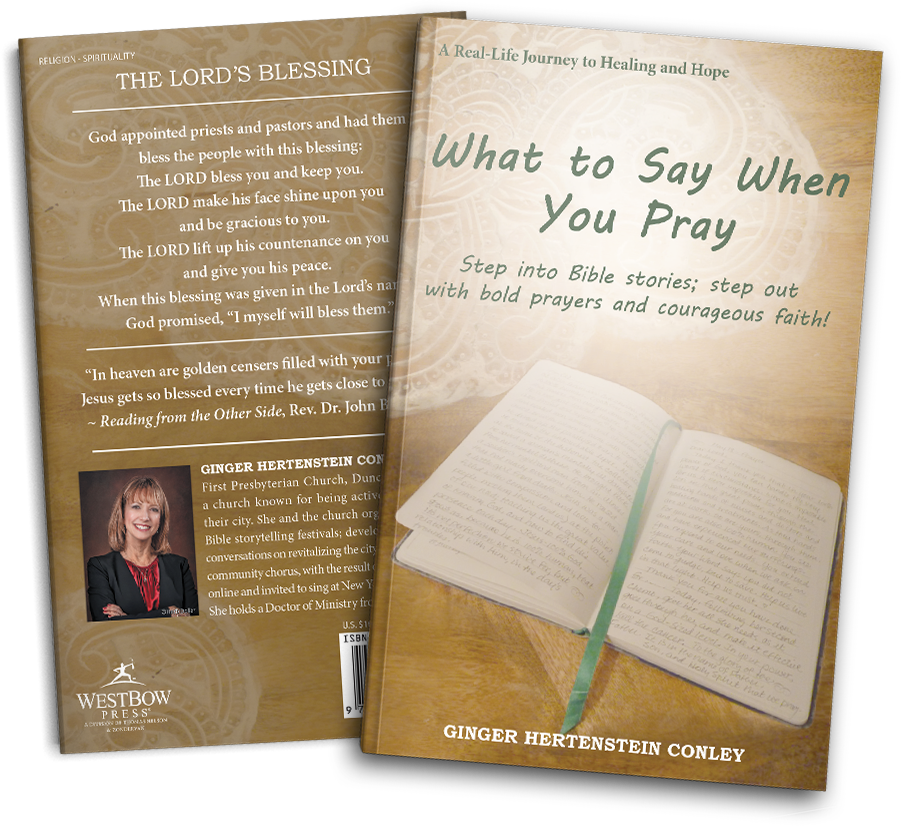
Have you received bad news and you don’t know where to turn? You pray, but the problem just grows bigger. Perhaps you cannot find the words to say nor relief from the anxiety of your ordeal. What to Say When You Pray guides you in the pursuit of God’s presence, peace, and power to assist with your need.
Ginger Hertenstein Conley explores the stories of people in the Bible who sought God’s help during all kinds of circumstances: natural disasters, political upheaval, and personal illness or loss. Drawing from both the Old and New Testaments she writes about how people leaned into their faith and it became real. As they turned to God in prayer or asked Jesus for help, healing of all kinds occurred—mental, physical, and spiritual. People found that prayer and personal connection with God, even in the most difficult times, resulted in blessings of peace, hope, and answers.
What to Say When You Pray tells the real-life journey of a woman with stage four cancer. Her family and friends decided to pray for her at the same time every week. May this book encourage you to seek God’s help with your own difficult, perhaps even impossible, situation. May you discover the assurance that God loves to hear and answer prayers.
Awards



Award-winning news
Hi Ginger,
We are honored to share the news that
your book has been announced a winner in
PenMasters Global Award for Literary Excellence.
Congratulations!
What to Say When You Pray new winner of PenMasters Global Award for Literary Excellence

Congratulations on Your FSBA Recognition
Winter 2025 Award Finalists

Dear Award Finalist,
Congratulations on your outstanding achievement in the Four Seasons Book Awards!
We are honored to recognize your work as part of our Winter 2025 Award Finalists, and we truly celebrate the dedication, creativity, and impact that your book represents. Being selected as a finalist is a significant accomplishment, and you should be incredibly proud.
Reviews
NY Wire: https://nywire.com/when-faith-gets-practical-instead-of-polished/
Miami Wire: https://miamiwire.com/when-prayer-stops-feeling-scripted/
The Chicago Journal: https://thechicagojournal.com/when-faith-feels-out-of-reach/
Texas Today: https://texastoday.com/when-prayer-doesn-t-go-the-way-you-expected/
California Gazette: https://cagazette.com/when-prayer-stops-feeling-scripted/
When Prayer Stops Feeling Scripted
Contributor May 2, 2026 Entertainment
By: Daniel Ortega
There’s a quiet tension a lot of people carry but rarely admit out loud.
They want to pray. They believe in it, at least in some way. But when the moment comes, the words feel awkward, forced, or just… missing. That’s where Ginger’s story begins, and it doesn’t start with a publishing plan or a big idea.
It starts at 7 a.m. on a Thursday.
A Routine That Turned Into Something Bigger
Ginger wasn’t trying to write a book.
She was invited into a small, consistent act. A group of people showing up weekly to pray for someone they loved who was facing stage four cancer. No spotlight. No audience. Just commitment.
Each week, Ginger did something simple but intentional. She wrote a short devotional and a prayer, then sent it as encouragement to the woman whose sister was fighting for her life.
That rhythm continued for a year.
Fifty-two weeks of showing up, writing, reflecting, hoping.
Then something shifted. The cancer was gone. And suddenly those weekly messages were no longer just private encouragement. They had become something with weight, something tested in real life.
That’s the moment the book took shape. Not as a concept, but as a response.
The Real Problem Isn’t Prayer, It’s Pressure
Ginger doesn’t approach prayer like a system that needs to be optimized. She goes straight at the discomfort people feel around it.
There’s this quiet assumption many carry. That there is a correct way to talk to God. That there are rules, maybe even unspoken ones, about what is allowed, what sounds right, what sounds off. That assumption creates distance. God starts to feel less like someone you can speak to and more like someone you need to perform for. Ginger cuts through that quickly.
Prayer, in her view, is not a performance. It’s a conversation. And like any real conversation, it doesn’t require perfection. It requires honesty.
Talking Like Someone Is Actually Listening
What stands out in Ginger’s approach is how grounded it is. She doesn’t describe prayer as something abstract or distant. She describes it almost physically.
Talking to Jesus like he’s sitting beside you.
Saying the things you’d usually filter out. Fear. Anger. Anxiety. The thoughts that feel too messy to say out loud.
That shift matters. Because the moment prayer becomes honest, it stops feeling like something you have to get right and starts feeling like something you can actually enter.
And that changes the experience entirely.
The Role of Scripture Isn’t What You Think
A lot of people assume reading the Bible is about discipline or obligation. Ginger frames it differently. For her, it’s about resonance. She reads until something lands. Not intellectually, but emotionally. A line, a moment, a story that feels like it’s speaking directly into whatever she’s carrying.
Then she stops. Not to analyze, but to sit with it.
That pause becomes part of the conversation. Almost like letting the response come back to you instead of forcing it forward. It’s a slower way of engaging, but also a more personal one.
Why Daniel Still Feels Relevant
When Ginger talks about biblical figures, it doesn’t feel like distant admiration. It feels practical.
Daniel, in particular, stands out to her for a reason that feels surprisingly current. He lived in an environment that didn’t share his beliefs. Pressure was constant. Risk wasn’t theoretical. And still, he maintained his habits.
Not loudly. Not performatively. Just consistently.
Prayer wasn’t something he turned to occasionally. It was something that anchored him daily, even when it came at a cost.
That kind of steadiness is what Ginger pulls forward. Not as a lesson, but as an example of what it looks like to stay grounded when everything around you is uncertain.
When There’s Nothing You Can Do
One of the most honest parts of Ginger’s perspective shows up when she talks about illness and uncertainty. Because that’s where prayer often gets tested. When there’s no action to take, no solution to apply, no control left. She acknowledges the simple truth first.
Prayer gives you something to do. That alone matters more than people realize. It interrupts the helplessness. But she doesn’t stop there.
Over time, she says, prayer does something deeper. It builds faith. Not in a sudden, dramatic way, but gradually, through repetition, through showing up again and again in moments where outcomes are unclear. That process reshapes how people experience uncertainty.
Worry tightens everything. Prayer, in her experience, creates space.
Confidence Without Certainty
There’s an idea running underneath everything Ginger shares. Confidence doesn’t come from having answers. It comes from connection. Through consistent prayer, people begin to feel less alone in what they’re facing. Not because circumstances change immediately, but because their relationship to those circumstances shifts. They start to trust that they can move through uncertainty without being overwhelmed by it.
That’s a quieter kind of strength, but it holds.
What This Book Is Actually Offering
It would be easy to describe Ginger’s work as a guide. But that doesn’t quite capture it.
What she’s really offering is an entry point. A way back into prayer for people who feel disconnected from it. Not by teaching them how to say the right things, but by removing the pressure to say anything perfectly.
The structure of the book reflects how it was created. Week by week. Moment by moment. Rooted in something real, not theoretical. And that origin shows.
Where It Leaves You
If there’s one thing that stays with you, it’s this. Prayer doesn’t need to sound impressive to be meaningful. It just needs to be real. And sometimes, that’s the hardest shift to make.
Because it requires letting go of the idea that you’re supposed to know what to say.
And trusting that showing up, even without the right words, is enough to begin.
